Yorkie Weight Chart
How to tell how big your Yorkie puppy will be full grown
How to calculate your puppy's weight
Many people want to know how big their Yorkie puppy will be fully grown. The Yorkie weight chart is a starting point — check the other size indicators below too, so you get an overall picture of all the factors. I have compiled all the methods and indicators you can use to get a good idea of your puppy's full-grown weight.
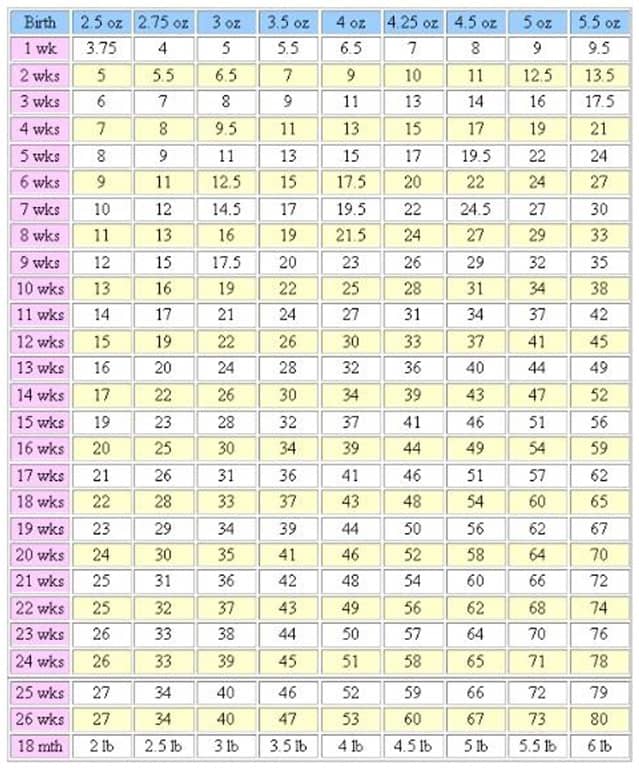
How to use the chart
Using the puppy weight chart is simple. Convert your puppy's weight to ounces (16 oz = 1 lb), then:
- Find your puppy's current age in the left column.
- Follow along that row until you reach your puppy's current weight (in ounces).
- Follow that column down to the bottom of the chart to find the estimated adult weight.
Key factors in knowing how big your puppy will be full grown
There are some important things to know when trying to figure out how big your puppy will be fully grown. This is important for anyone who really wants a puppy that will stay a certain size — most of my clients are second-time buyers who bought a Yorkie before that the breeder said would be 5 lbs and ended up at 10 lbs.
The older a puppy is, the more accurate the charting. Charting a very young puppy is only a rough indicator; it sharpens as they grow.
The size of the parents is a strong indicator. The problem I see most is a puppy from a bigger mom — say 7 lbs — and a 2.5 lb dad, where the 2.5 lb dad could have parents that are both 7 lbs. The genetics that affect a puppy's size go back five generations, so it is important to know what's behind each parent.
Puppies can flip-flop. I have seen a puppy chart small and its sibling chart big, and when fully grown the one charting smaller got huge and the one charting bigger stayed tiny. Charting is not 100% — genetics is very complex, and the chart is only an indicator.
Paw size is another helpful indicator. Compare a puppy's paws to its littermates — bigger or smaller paws can hint at a bigger or smaller adult.
Know the lines. Good breeders who have bred for years know their lines going back generations — they know what a female will produce and what is behind the parents. Sometimes a small stud will throw big puppies regardless of the female. If one parent has strong genetics for size, it won't matter who they are bred with — they will keep producing that size. Look at past litters from the same parents when you can.
DNA size prediction. I have had great success with Embark testing — the full panel includes an adult-size predictor. Take all of these things into account together; none of the indicators is solid on its own.
Watch: evaluating your Yorkie's adult size
A walk-through of how we read a Yorkie puppy's charting and size indicators.
Yorkie Weight Predictor
Enter your puppy's exact age and current weight and we'll do the charting for you.
Estimate the Adult Weight
Enter an age and current weight above to see the estimate.
This is an estimate, not a guarantee. Every puppy grows on its own curve, and factors like genetics, parentage, nutrition, and health all shift the final number. Predictions are most reliable between about 8 and 16 weeks of age. For the tiniest micro and teacup Yorkies, always plan for a healthy range rather than an exact target.
Yorkie Growth Reference
Roughly what percentage of adult weight a Yorkie has reached at each age.
| Age | Share of adult weight |
|---|---|
| 6 weeks | ≈ 25% of adult weight — multiply current weight × 4 |
| 8 weeks | ≈ 34% of adult weight |
| 10 weeks | ≈ 42% of adult weight |
| 12 weeks | ≈ 50% of adult weight — roughly half grown |
| 16 weeks | ≈ 63% of adult weight |
| 6 months | ≈ 80% of adult weight |
| 9–10 months | ≈ 100% — most Yorkies are done growing |